Tallystick counts the support tickets your docs assistant kept from arriving
It reads your Zendesk or Intercom export once a month, sorts each ticket with a classifier, and prints the tickets that did not come, measured against a holdout of your own docs browsers. At Intercom’s $0.99 per Fin outcome, 2,000 outcomes a month is $23,760 a year, billed on a figure nobody has tied to a ticket.
One holdout month from your own export. The count is back before the renewal call.
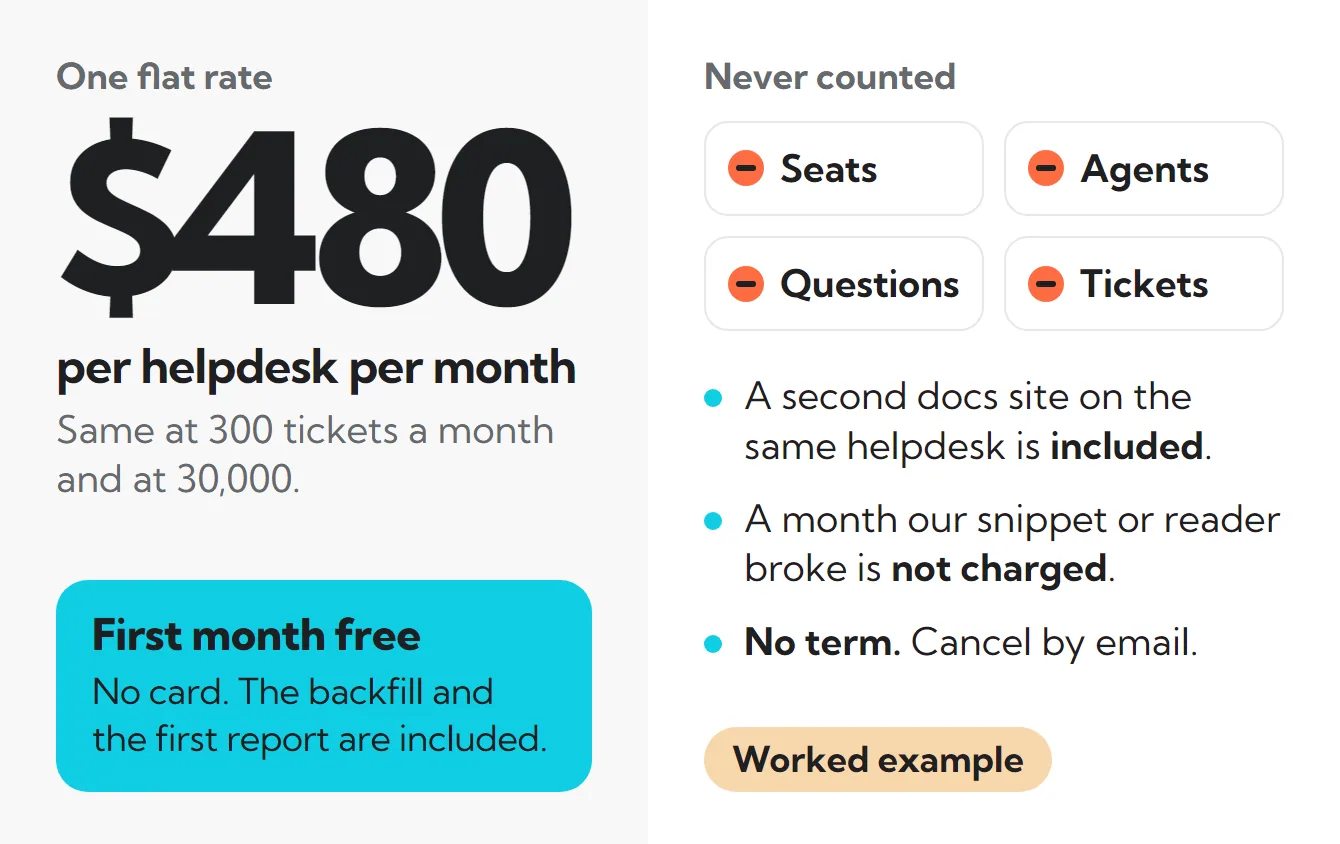
- $480 per helpdesk per month, flat
- 10% of docs browsers held out, every month
- 90% interval printed under every count
From the export
The renewal is argued on one number, and today the seller holds it
Usage beyond what the vendor calls typical patterns triggers a repricing conversation.
- 0148%the only published ticket drop, A/B tested by the customer
- 02$0.99per outcome, the only unit price printed in the category
- 030dollar figures on the assistant vendor’s pricing page
Built from your own export, checked by a test you can rerun
- Zendesk and Intercom, read-only token
- CSV export from any helpdesk
- First-party cookie, 90/10 split
- Two-proportion test, 90% interval
- Human review under 0.85 confidence
- Cloud infrastructure in Dublin
Every ticket is redacted before it is classified. The arm field on each ticket lets a spreadsheet rerun the test.
The report, screen by screen
The months table and the sheet for Finance
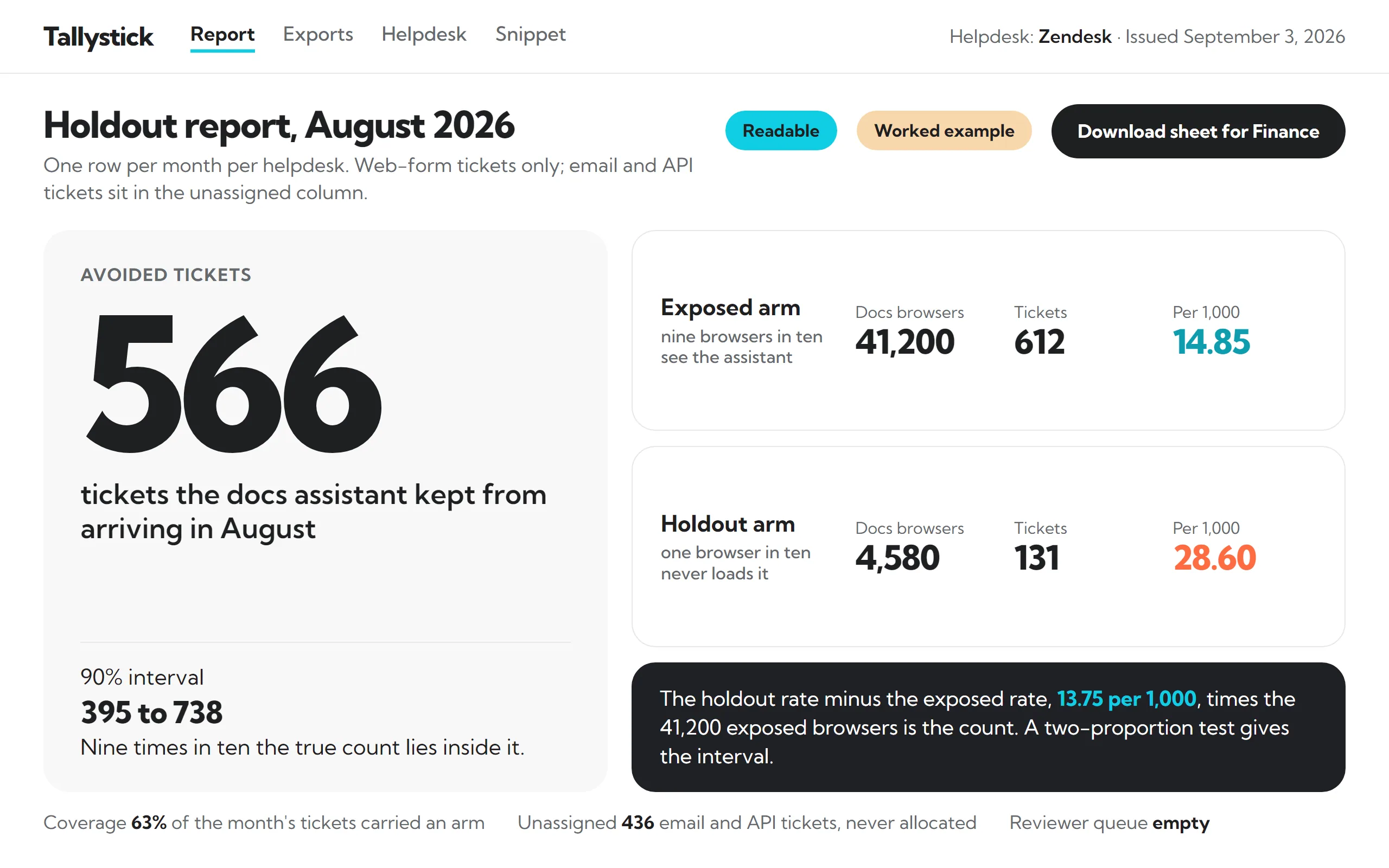
A worked example at one helpdesk’s scale: each month’s count with its interval, and the one-page sheet for the renewal call.
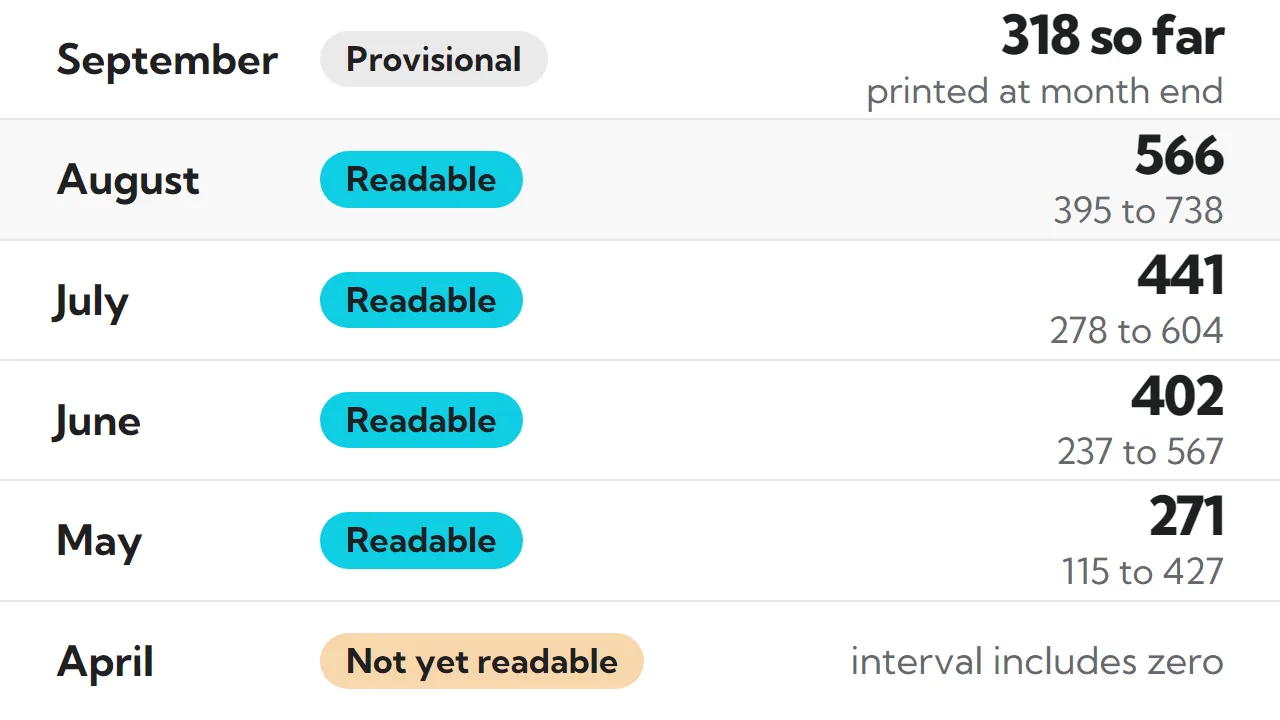
One row per month with the interval under the count. The current month stays provisional; a month whose interval includes zero reads Not yet readable.
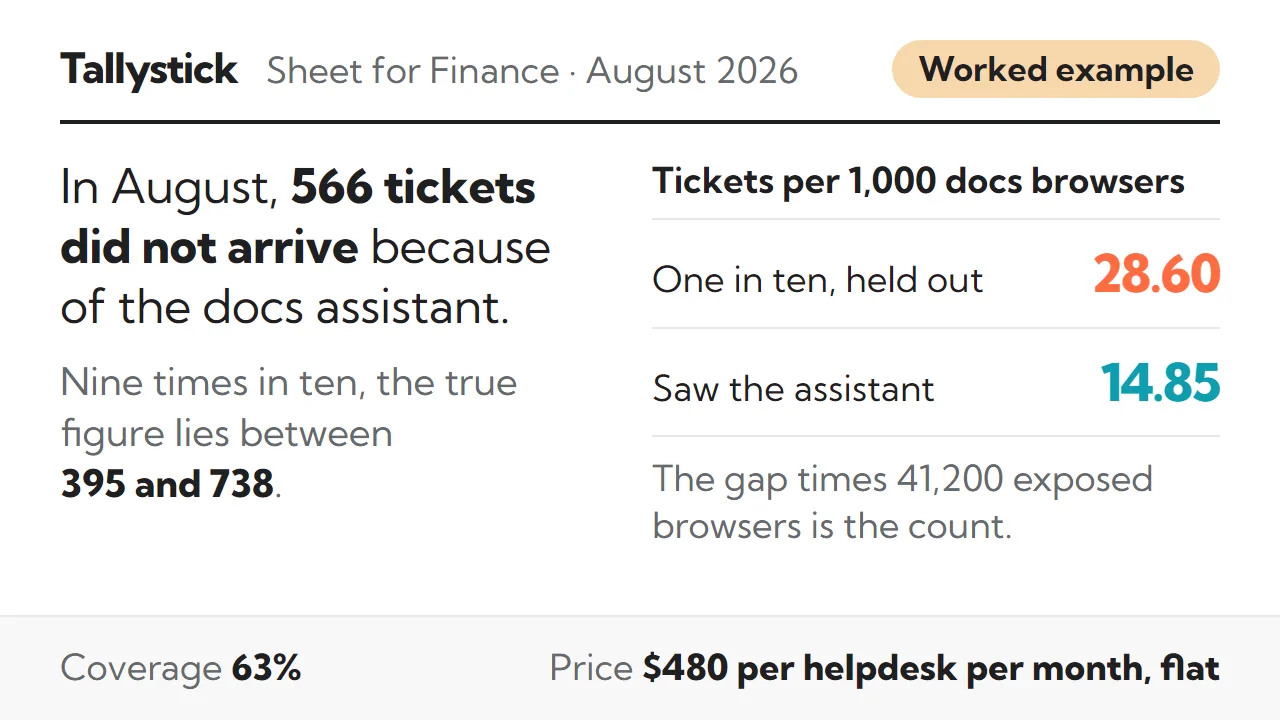
The sheet for Finance
The count, its interval, the method and the flat price on one page, in the sentence a CFO reads before the renewal call.
What the models read
Five classes for every ticket, sorted after the names come out
A classifier sorts what the rules cannot; an embedding model matches each docs-answerable ticket that still arrived to its docs page.
Redacted first
The classifier reads a ticket's subject and first message after emails, URLs, names and identifiers are stripped.
Five classes
The split tests the holdout: if the assistant seems to cut bug reports, the holdout is broken.
Under 0.85
One of our reviewers assigns the class from the redacted opening; the month's report waits.
Reviewed pairs
Each reviewer's class, stored with its redacted opening, trains your classifier alone unless you join the pooled corpus.
One flat rate
$480per helpdesk per month, flat. Seats, agents, questions and tickets are never counted.
- Twelve-month backfill and the class split
- The monthly report as web table, PDF sheet, CSV and JSON
- A second docs site on the same helpdesk
- First month free, no card, backfill and first report included.
- A broken month is not charged; a wrong report is re-issued and credited.
- No term. Cancel by email; pulling the snippet ends the holdout that day.
A count without a control is the vendor’s count in a different font.
Tallystickon why the holdout runs every month and not once
How the count is made
How 41,200 browsers and 743 tickets become one count
Worked through on an example helpdesk that took 743 web-form tickets in a month.
Split
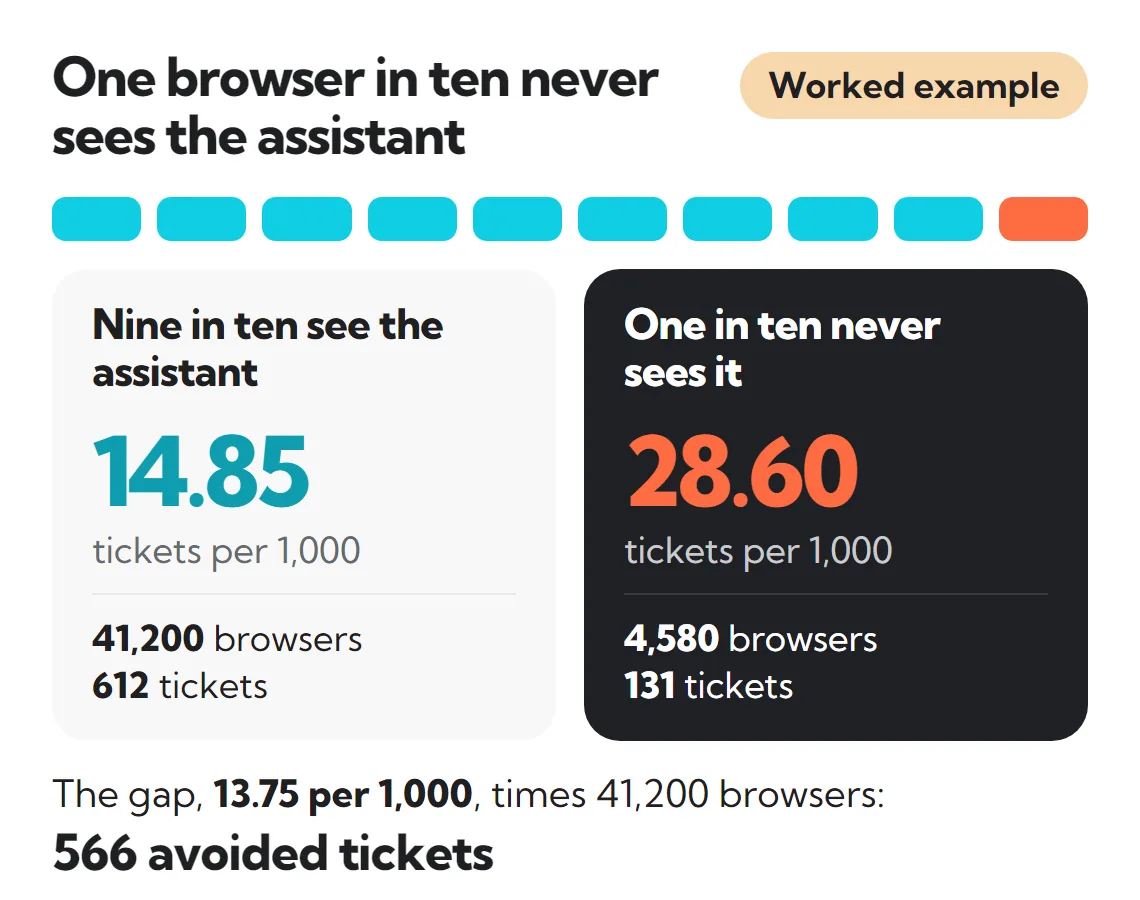
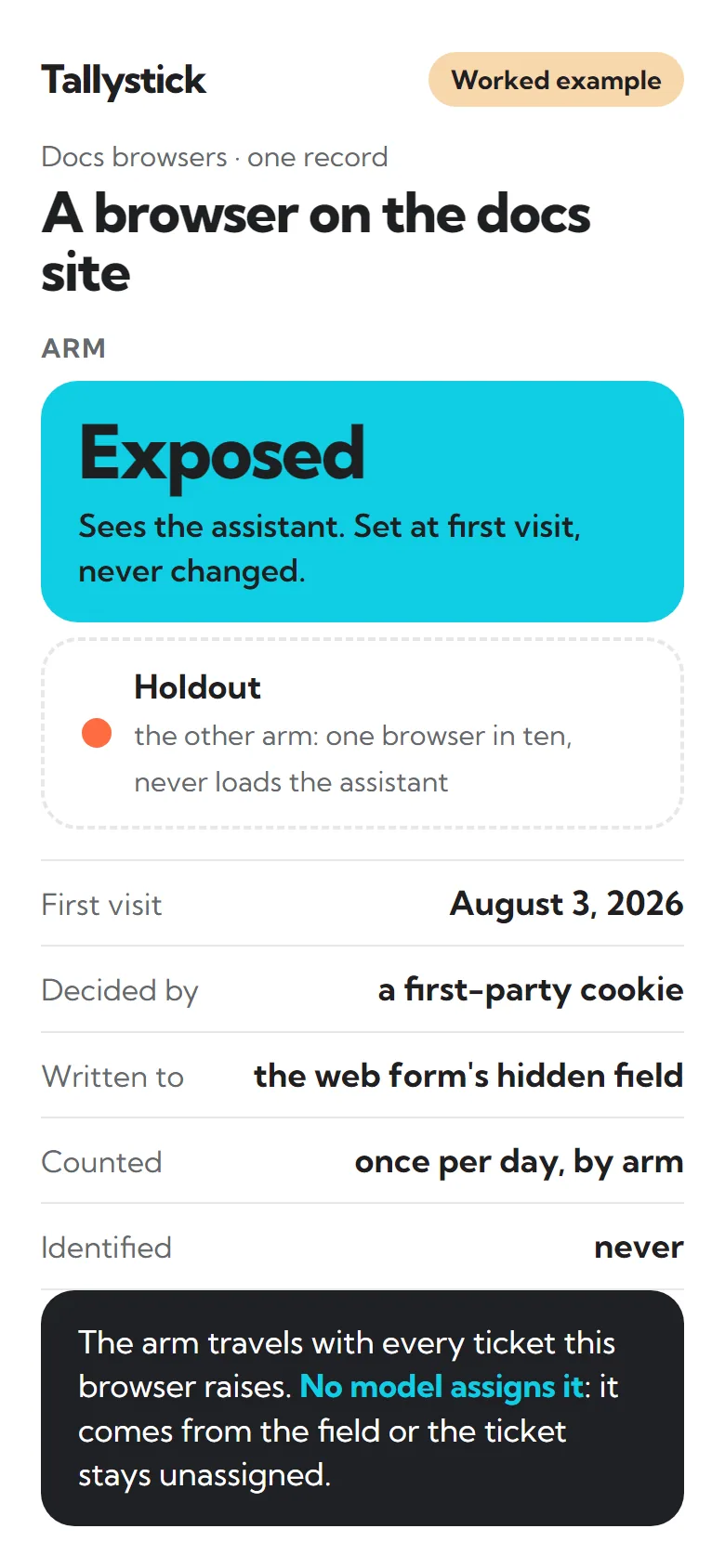
The docs template snippet hashes a first-party cookie: 90% see the assistant, 10% never load its script.
Tag
The same snippet writes ts_arm into the web form, as a hidden Zendesk field or an Intercom attribute.
Read
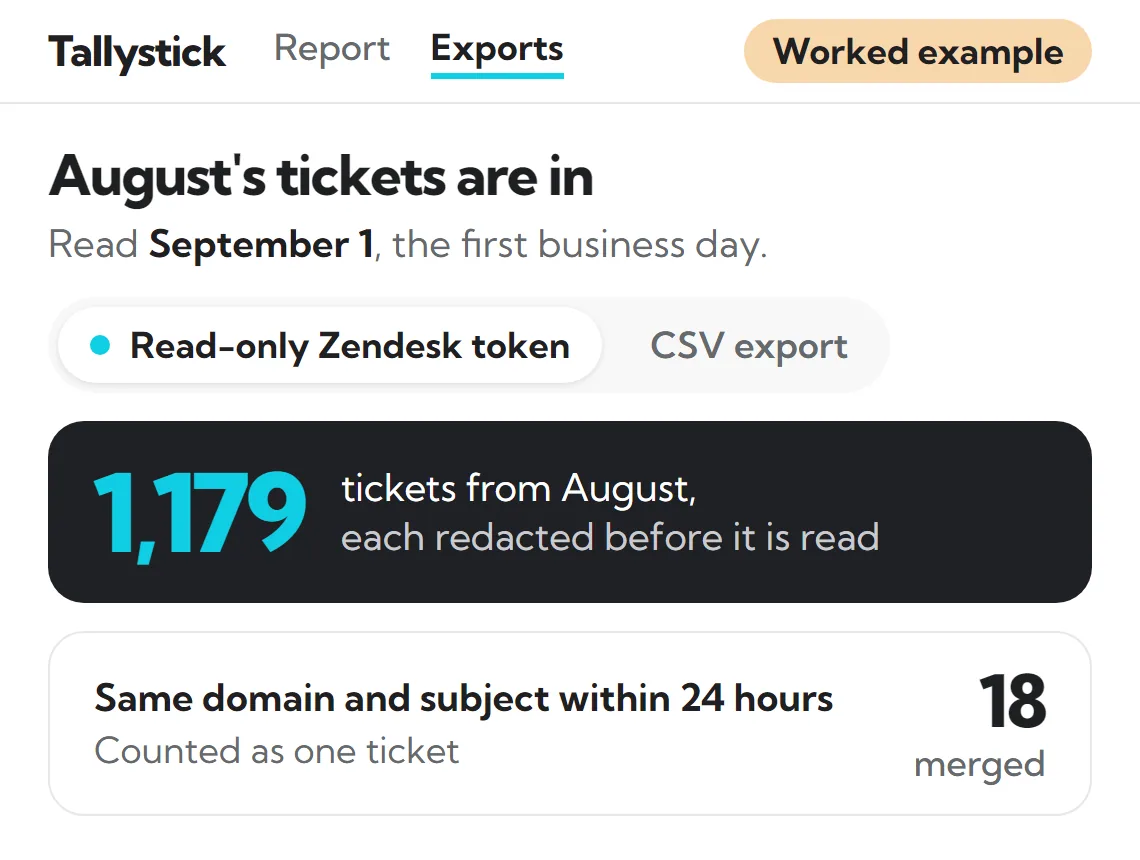
On the first business day a read-only token or CSV export brings the month’s tickets, redacted. Same domain and subject within 24 hours: one ticket.
Classify
Rules over tags and form choices first, a fine-tuned open-weight classifier next, a reviewer under 0.85.
Count
612 tickets over 41,200 exposed browsers is 14.85 per 1,000; 131 over 4,580 holdout is 28.60. The 13.75 gap times 41,200: 566, interval 395 to 738.
Gap
Docs-answerable tickets that still arrived are matched to the page that should have answered them.
Why a holdout month
One browser in ten never sees the assistant, for as long as the report runs
A tenth of the tickets the assistant would have avoided still arrive.
A holdout switched off after a test is a memory by the renewal. Ten percent stays out, so the number at the call is last month’s.
The assistant’s answered-question count drops by the same share, and the vendor will notice.
A count billed by volume would move with the figure it checks, so this one is flat.
Unassigned stays unassigned. Email and API tickets are never allocated by ratio.
Coverage prints beside the count: 40% coverage describes 40% of the queue.
An interval that includes zero reads Not yet readable, renewal or not.
300 tickets a month pays the 30,000 rate and waits months longer.
Who it is for
$5,760 a year buys a count only if all three are in place
An assistant to hold out, a web form to tag and a helpdesk to read. Missing one, there is no row to price.
This is for you if
- ✓A support director with an assistant live and a renewal sized to expected usage.
- ✓A Zendesk or Intercom queue, or any helpdesk that exports CSV, fed mostly through the docs web form.
This is not for you if
- ✕No docs assistant live yet. Nothing to hold out, nothing to count.
- ✕Tickets arrive mostly by email or API. They carry no arm, coverage prints under 40%, and the count speaks for that share only.
- ✕A helpdesk you will not name. We cannot read an unnamed export.
- ✕You want the questions answered. There is no widget and no search; that stays your assistant’s job.
One counted month
The row Finance reads, with the interval under the count
One row per month per helpdesk, with the current month at the top marked Provisional.
| Month | Exposed, per 1,000 | Holdout, per 1,000 | Avoided tickets | Coverage |
|---|---|---|---|---|
| Sep 2026, provisional | 15.3 | 27.9 | 318 so far | 61% |
| Aug 2026 | 14.9 | 28.6 | 566 (395 to 738) | 63% |
| Jul 2026 | 15.8 | 27.1 | 441 (278 to 604) | 62% |
| Jun 2026 | 16.4 | 26.5 | 402 (237 to 567) | 60% |
| May 2026 | 17.1 | 24.0 | 271 (115 to 427) | 58% |
| Apr 2026 | 18.2 | 21.7 | Not yet readable | 44% |
Not a deflection dashboard and not a quality score. Email and API tickets sit in an unassigned column, out of the arithmetic.
Starting takes a work email, the helpdesk’s name, a read-only token or CSV, the hidden arm field and the snippet.
You keep a dated PDF sheet, plus CSV and JSON of the same rows, licensed for Finance, auditors and the assistant vendor.
Before the renewal call
Thumbs-ups, a bigger holdout and forum threads
- Why not credit every thumbs-up as a deflected ticket?
- A thumbs-up is a rating; only a holdout counts tickets that never came.
- Can we hold out 20% instead?
- Yes, and you should under 1,000 tickets a month; the interval clears zero sooner.
- Do Slack or Discord answers count?
- No. PostHog’s assistant answered 247 of 759 resolved forum threads, posting only when confident, and that count stays the vendor’s.
Bring your own count to the renewal call
Leave a name, work email and company. We reply with the token instructions for Zendesk or Intercom, or the CSV column list for anything else.
We reply within one business day.
- ✓ Within two days, twelve months of tickets come back classified.
- ✓ First readable row on the third business day after a full month
- ✓ First month free, no card, no term
- ✓ A CSV can come by upload, SFTP or an Azure Blob container